Media A1:
News and Online Media
Theory, Industry and Context
The Guardian Front Covers VS The Daily Mail Front Covers:


After collecting a few of the recent front cover pages from the newspapers The Daily Mail and The Guardian it is quite clear to what position they both stand in politically. For example, The Daily Mail is considered to be a newspaper that expresses the right-wing perspective which has become more clear once researching these covers. Whereas, The Guardian expresses the opinions and perspectives of a centre/left-wing view, also becoming clear during this research process.
How news is shaped by how it is produced, distributed and circulated.
Definitions
Production - the process of making a media product. Every industry has its own forms of production.
Distribution - the process of making a media product available to audiences so that they can consume it, which includes aspects of marketing such as creating an advertising campaign.
Circulation - a count of how many copies of a media product are distributed. This can include physical distribution and subscription.
Print Production:
The news Industry is concerned with the production, distribution and circulation of news information and entertainment.
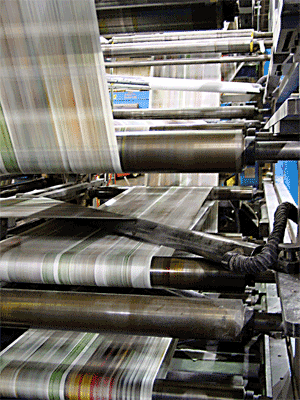
Today’s UK News papers are
•created using a process called off set printing
•They require large amounts of material
•The employ mainly highly trained staff
Print News is deadline driven with a typical turn around time of 24 –hours.
News Circulation:
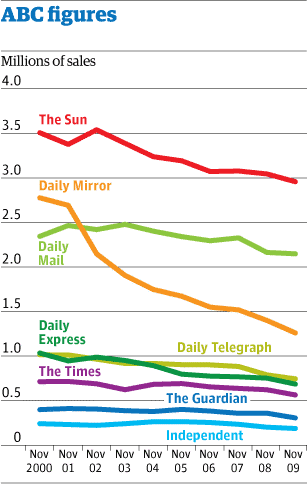
-Refers to the number of newspapers that have been distributed (not sold). Circulation figures are important because they are used to set advertising rates.
-Print Newspaper sales have declined significantly over the past two decades which has had a significant effect on the way newspapers run their business.


Ownership and Control:
Ownership refers to who financially supports and produces the paper. Newspaper owners may acquire more than one brand (consolidation) which helps the owner target different audiences, gaining a larger market share.
In the UK there are three different ownership models...
1.Media barons – wealthy owners/proprietors
2.Trusts – a legal arrangement where the finances from the owner are transferred to a “trustee” to manage the newspaper
3.Cross media converged conglomerates (Rupert Murdoch News Corp up until 2018 owned: News UK, 20th Century Fox and part owned Sky)
Weekly market share of UK newspapers (2018):

Left-Wing Newspapers:
-
The Daily Mirror
-
The Daily Star
-
The Sunday People
-
The Guardian
-
The Observer
-
The Independent
Right-Wing Newspapers:
-
The Sun
-
The Daily Mail
-
The Daily Express
-
The Sunday Times
-
The Daily Telegraph
-
Financial Times
Which two companies own 60% of the British Press, what is their political affiliation?
60% of the British Press is owned by companies with the political affiliation of the right-wing perspective, meaning the majority of the British Press is implying a right-wing.
Why might Press ownership be important in shaping the British public views on political issues such as Brexit, voting for political parties?
In today's society the media we are presented with is extremely constructed and may influence the audiences response and following conclusions made. Therefore, if 60% of the British Press is considered to have the political affiliation of right-wing, it may create the British public views to be more often then not leaning towards the right-wing perspective. This would also effect the opinions of the British public, hence creating an effect when Britain are voting for certain political parties. For example, if a right-wing based newspaper presents a certain right-wing political party in a positive light it may influence Britain to stand behind that political party. In comparison certain newspapers may present a left-wing political party leader in a very negative light which creates the British public to once again leaning towards the right-wing political affiliation.

The Daily Mail is a right-wing political affiliation newspaper. They are clearly representing Jeremy Corbyn (a left-wing political party leader) in a very negative light, which causes the audience to see him and his political party in a negative light. Therefore, creating the British public to lean towards the right-wing political parties in following votes for political parties.
Economic Factors:
(such as funding for news)
British newspapers must attract audiences to make money and survive.
2015 UK newspaper industry contributed £5.3 Billion Gross value added and supports £87,500 jobs.
Print Newspaper production is financed through print sales and advertising revenue.
Circulation sales
•14.3 million people read a newspaper every day.
•81% of newspaper revenue comes from circulation sales.
•The cost of a Daily Newspaper ranges from 30p to £2.70 with the Daily Mail retailing at xx p and Guardian xx per day (Task find out what the costs are!)
Advertising
•Advertisers pay for space in the paper
•Advertising in national newspapers is expensive, depending on the paper’s circulation figures and audience (A, B, C1, , D, E)
•The cost of a full page colour advert in the Daily Mail is £30,000
•Newspapers now make money from adverts in off line (print) and online (digital) editions
•Readers of print newspapers are more likely to read an advert than online readers.
ALTERNATIVE METHODS OF FUNDING PRINT NEWS INCLUDE:
Subscriptions and donations
•Online subscription fees known as paywalls, which pay for online services and also fund print papers (Task find out what the subscription costs are for the telegraph and the Guardian)
•Reader donations and memberships


The impact of “Technological developments”
Many developments such as the introduction of colour off set printing have benefited owners making newspapers more appealing to readers and quicker to print.
Since the 1980’s rapid developments in digital technology in terms of hardware, software and converged devices have significantly changed the relationship between news owners and their audiences.
Over the past 20 years, since the introduction of web 2.0 in 2004 the print industry has undergone significant changes in production, distribution and circulation.
•To remain relevant for audiences and tackling falling sales of print copies, newspapers have expanded their copies online. This has a number of advantages online for owners:
•Production via websites reduces environmental costs of producing with paper and ink.
•Distribution via the internet reduces the cost of physical distribution and enables news outlets to reach a global audience.
•Circulation via websites and mobile devices allows audiences to access news and advertising online through apps and social media.
-This increases circulation numbers for the news outlet.
-Allows audiences to share and interact with the news.
-Enables owners to monitor which stories are most popular.

Examples of Online News:

The Guardian is representing the image of the Queen being almost quite graceful to give up her real fur clothing. Whereas there are a lot of other important issues that I personally believe should be being discussed instead of the Queens fashion. A subject like this may create a number of different opinion on to why the Queen had the fur coats to begin with or the idea of going fur free is extremely graceful and selfless.
Soft News: is background information or human-interest stories (arts, entertainment and lifestyles)
Hard News: generally refers to up-to-the-minute news and events that are reported immediately (politics, war, economics and crime)
Biased Newspapers:

Nigel Farage is the leader of the Brexit Party and is being portrayed in quite a negative light within this newspaper front cover. The Guardian is a newspaper that presents the centre/left-wing perspectives and opinions. Hence why it is representing Farage in this type of light, influencing the centre/left-wing opinion onto the readers of this newspaper. Therefore, highlighting how biased newspapers are in today's society.
Cultivation Theory: suggests that exposure to media, over time, subtly 'cultivates' viewers' perceptions of reality. Gerbner and Gross assert: "Television is a medium of the socialisation of most people into standardised roles and behaviours. Its function is in a word, enculturation"
Ownership-
In the UK newspaper titles are thought of in terms of left and right wing. This has become a way of describing the political ideologies of the newspaper and how they shape and tell their stories. The more right-wing a paper is the more conservative and traditional its views and political agenda will be.
Over 60% of newspapers in circulation in the UK...
-
are right wing
-
broadly support and reflect the values of the conservative party
-
are owned by wealthy, white, male media barons/proprietors who control global media outlet
Newspaper owners are aware of the power they have in influencing their readers to make national and political decisions that support the papers political agenda.
The Guardian: Editor- Katharine Viner, Owner- Scott Trust Limited
The Daily Mail: Editor- David English, Owner- Jonathan Harmsworth
The Telegraph: Editor- Chris Evans, Owner- The Barclays Brothers


The Sun is a newspaper expressing the right-wing perspective against immigration This links to the capitalist mindset who believe that the rich should stay richer if groups of immigrants shouldn't be entering our country and attempting to take the jobs of the Brits.
The Guardian is a newspaper who represent the opinions of the left wing perspective which is implying a sense of sympathy for people experiencing unemployment. It specifically states that this group experiencing unemployment is 'young black men'. This newspaper expresses the socialist mindset of everyone being equal and deserving a chance in situations like achieving employment.
Political Bias:
•Historically the Daily Mail is sympathetic to the right wing
•Harold Harmsworth in the interwar years supported right wing movements including – Oswald Mosely’s black shirts.
•1980’s Daily Mail supported Margaret Thatcher’s conservative party.
•Paul Dacre editor supported Brexit.
•2018 on wards – editor Geordie Gregg
•The Daily Mail has a hugely significant amount of political power and reach.
•74% of its readers voted conservative in the 2017 General election.
•The newspapers reach – means that it can influence the decisions of a large percentage of the British public
The Role of Regulation in the News:
Arguments for and against the regulation of the news revolve around two opposing views:
•For: the News Industry has too much political power and influence over the British public, which has reduced freedom of speech, compromises democracy and is not in the public interest.
•Against: The printed press should not be regulated or controlled, especially not by government legislation. This would effect freedom of speech, democracy and would not be in the pubic interest.
Regulation of the UK News industry focuses on:
•News content and information printed by the Press
•Ownership and competition laws


Katie Price was coming to terms with a new low from sickos who mock her severely disabled son Harvey.
This time it is claimed the vile abuse directed at the vulnerable 17-year-old came from three police officers.
The trio are facing an investigation over allegations of a horrifying troll video.
Mum-of-five Katie, 41, will be devastated by our revelation.
It is the latest in a string of attacks on Harvey , who is partially blind, autistic and has weight issues due to hunger-inducing Prader-Willi syndrome.
Last night a source said: “Katie is sick to the back teeth of people making her son the butt of tasteless jokes.
In my opinion, the abuse that Harvey is receiving from both anonymous trolls or supposedly police officers is disgusting. He is still a human being and deserve to be treated the same as everyone else. He already suffers with a group of disabilities himself, and it is not fair that people have taken it up on themselves to bully him for something he simply has no control over.
The British Press is self regulated. This means that an independent organization made up by editors regulates itself to assure adherence to an accepted code of conduct in the production of news content.
•Editors are punished if they breach regulations (fines or public apology)
In 2011 following the Leveson enquiry (which found the Press to have too close a relationship with politicians/government) The Leveson report recommended that future Press regulation should
•Continue to be self regulated outside of government
•Create a new press standards body, created by the industry with a new rigorous code of conduct.
•To back up regulation with legislation to ensure the press remains independent and effective
•To provide the public with confidence that their complains will be dealt with effectively
•To protect the press with government interference.
IPSO – Independent Press Standards Organisation:
-
holds newspapers to account
-
protects the rights of the individual
-
upholds standards of journalism
-
maintains freedom of expression for the press
IPSO is funded by the national daily newspaper titles that are members of the body. The public can submit complaints against member newspapers without having to go through the courts and IPSO investigates the complaint.
IPSO newspaper members include...
-
The Daily Telegraph
-
The Sunday Telegraph
-
The Daily Mail
-
The Mail on Sunday
-
Metro
-
The Times
-
The Sunday Times
-
The Sun
-
The Daily Express
-
The Sunday Express
-
The Daily Star
-
The Daily Mirror
-
The Sunday Mirror
-
The Sunday People
Press – Regulation Successful Complaints:
Decision of the Complaints Committee Chapman vs Daily Mirror
Summary of complaint
1. Gillian Chapman complained to the Independent Press Standards Organisation that the Daily Mirror breached Clause 1 (Accuracy) of the Editors’ Code of Practice in an article headlined “Suicide over menopause”, published on 30 June 2018.
2. The article – a ‘news in brief’ report of an inquest - stated that “a former mayor killed herself after struggling with the menopause”. It named this individual as ‘Gillian Chapman, 55’. It described how the woman was found dead by her daughter, and named the location of her home. The article included a photograph of ‘Gillian Chapman’.

3. The complainant said that the article was inaccurate in breach of Clause 1 (Accuracy) because it had wrongly stated that she – the former mayor of the Borough of Dacorum – was dead, when in fact the inquest had related to another woman of the same name. She said that the image in the article was of her, not the other woman.
4. On receiving the complaint via IPSO, the publication accepted that it had published a significant inaccuracy that required correction. It subsequently offered to write a personal letter of apology to the complainant, and to publish the following correction on page 2 of the print newspaper:
An article published on 30th June 2018 reported on the inquest into the suicide of Gillian Chapman. The article included inaccurate information supplied by a news agency that identified Ms Chapman as the former mayor of Dacorum. The subject of the inquest had the same name but was not the former mayor. We would like to clarify that Gillian Chapman, the former mayor of Dacorum, has not passed away, and has no connection to the events described. We would like to apologise to Mrs Chapman for the error and any distress caused.
5. The publication denied any breach of Clause 1, however. It said the story had been provided by an agency, which had failed to appropriately check the facts of the story. The publication said that it was reasonable for it to rely on the agency to correctly identify the subject of an inquest story; therefore, it had not itself failed to take care over the story’s accuracy, in breach of Clause 1.
6. Clause 1 (Accuracy)
i) The Press must take care not to publish inaccurate, misleading or distorted information or images, including headlines not supported by the text
ii) A significant inaccuracy, misleading statement or distortion must be corrected, promptly and with due prominence, and — where appropriate — an apology published. In cases involving IPSO, due prominence should be as required by the regulator.
Press – Regulation Unsuccessful Complaints
Rescue boats? I’d use gunships to stop migrants! !
Katie Hopkins, 17th April 2015 The Sun
"No, I don’t care. Show me pictures of coffins, show me bodies floating in water, play
violins and show me skinny people looking sad!
I still don’t care!
Because in the next minute you’ll show me pictures of aggressive young men at Calais,
spreading like norovirus on a cruise ship!
Watching them try to clamber on to British lorries and steal their way into the UK, do I feel
pity? Only for the British drivers, who get hit with a fine every time one of this plague of
feral humans ends up in their truck!
Understand this, these two populations are the same. The migrants harassing Brit truckers
at the port are the same as the vagrants making the perilous trip across the Med!
And there is no stopping them. 170,000 came last year!
During a recent operation by the Italian coastguard to rescue migrants off the coast of
Libya, the people traffickers threatened crew with Kalashnikovs to get their vessel back!
Clearly, boats are in short supply. And that is a good thing. No boats, no migrants!
There is a simple solution to this. It’s time for the Italians to stop singing opera, drinking
espresso and looking chic in chuffing everything!
It’s time to get Australian!
Australians are like British people but with balls of steel, can-do brains, tiny hearts and
whacking great gunships!
Their approach to migrant boats is the sort of approach we need in the Med!
They threaten them with violence until they bugger off, throwing cans of Castlemaine in an
Aussie version of sharia stoning!
And their approach is working. Migrant boats have halved in number since Australian
Prime Minister Tony Abbott got tough!
We don’t need another rescue project. The now defunct £7 million-a-month Mare Nostrum
— Italy’s navy search and rescue operation — was paid for (in part) by British taxpayers


Press Regulation – The Daily Mail:
Example of a successful complaint
15 December 2017, the paper ran a full page story regarding compensation granted to an Iraqi man who was wrongly imprisoned and mistreated by British soldiers. In the case of Khan vs the Daily Mail, IPSO found the daily mail in breach of its guidelines by:
-
Publishing inaccurate, misleading or distorted information, including headlines not supported by text
-
A significant inaccuracy or misleading text
-
Not distinguishing clearly between comment and fact

Industries and the Set Products – The Guardian
Initially known as the Manchester Guardian and founded in 1821.
Today’s Guardian News and Media ltd is one of the UK’s leading Media organisations .
Although the U Gov survey places them as left of centre they state that their journalism does not have commercial or political interference.
The Guardian Media Group includes the Guardian and Observer newspapers and theguardian.com.
The Scott Trust owns the GMG, its aim is to secure the papers independence and ensure that no single owner can buy or control the paper. The Trust’s purpose is to
•Safeguard the The Guardian from political interference
•Protect the Guardian’s news values of honest, fair, liberal investigative journalism.
Economic Models and Funding:
In 2016 the GMG established a new business plan to address the economic losses associated with the decline in print circulation and loss in revenue.
The aimed to:
•Enhance operating efficiency
•Reduce costs by 20%
•Secure new growth opportunities for the GMG as a global organisation
•Adapt to changes in the advertising market
In response the Guardian has been successful in developing alternative funding and revenue streams.
1) Donations
More than 800,00 readers fund the Guardian:
•570,00 regular supporters
•375,00 one-off contributions
2) The Scott Trust
The Trust focuses on socially responsible investment and all profit from these investments supports GMG
The Trust set up theguardian.org a non profit organisation that raises funds from groups or private donors
3) Philanthropic contributions
These come from wealthy donors such as Bill gates (former Microsoft owner)
4) Reducing production Costs
•In 2018 the size format of the paper changed from a Berliner (European format) to a a tabloid.
•The reduction in size format saved the newspaper £19 million
•The cover price for the newspaper was increased to £2.00 in 2016 and £2.20 in 2019.
5) Offsetting losses with digital versions of the brand
•Digital revenues have increased by 15 percent since 2016
•The digital arm of the Guardian comprises 50% of GMG revenue
News Gathering and News Values:
The Guardian has had a long association with serious quality journalism, its social roots (Manchester) have also lead it to highlight the arts and culture for the public good. The news values of the paper reflect the lives of the public from all cultures and walks of life.
The Guardians current editor Katharine Viner prioritises stories that are in the public's interest and for the common good, and if they effect equality and freedom.
Journalists need to report on all forms of public life including different cultures, diverse perspectives and community services.

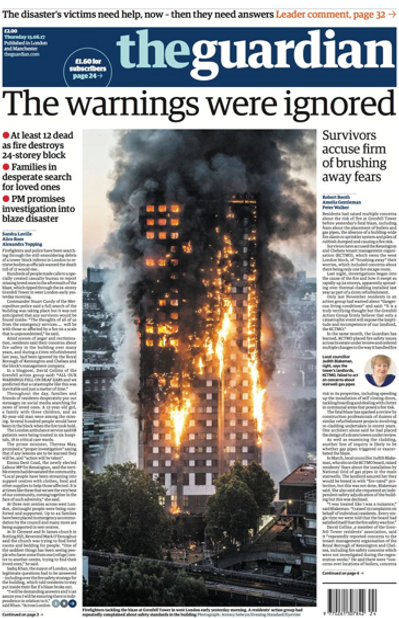

This Guardian front cover is discussing the NHS and how they are being so under payed. This portrays a sense of sympathy towards the NHS and highlights the perspective and opinion of the left-wing, socialist mindset that the Guardian stands by.
Audience...
Market Segments:
Audiences can be divided up by statistical data such as age, gender (socio-economic) or by behaviour (uses and gratification) and experiences such attitudes to social issues. Segmenting audiences in such a way ins such a way helps newspapers understand audiences better.
Audiences can be segmented...
•Demographically
•Psychrometrically
Demographics:
-This groups a population into specific categories such as GEARS (gender, ethnicity, age, region and socio-economic).
-Demographic profiling focuses mostly on age, gender, income and occupation.
Psychrometrics:
-Psychrometrics is another way of categorising audiences. One way is to use VAL’s typology which consists of...
•Values
•Attitudes
•Lifestyle or behaviour


This newspaper front cover is presented by the tabloid newspaper The Sun. There is an element of play-on words that indicate an inappropriate joke initially. This could suggest it is aimed for the audience group of skilled working-class/working-class (C2/D) due to the very childish jokes being made within the headline, the headline being very important in catching the readers attention and causing them to want to read the newspaper. The headline is also in big, bold writing, especially the words 'BACK, SACK and CRACK' (emphasising the initial inappropriate joke). There is also a small amount of writing on the front cover of this newspaper, suggesting the audience to be less intellectual and prefer to view images rather than reading. This could also be because of the working-class group not having a huge amount of time when commuting to and from work. There is also a suggestion that this newspaper audience is more towards the age range of 20-50 years due to the jokes being made throughout the headline. Therefore, this newspaper being aimed for skilled working-class/working-class could also be identified by the small price being proudly advertised at the top of the page; 'JUST 40p' creating the idea of getting a 'bargain' when purchasing this newspaper. This newspaper perspective is known to be a right-wing newspaper but is not 100% clear in this particular front cover.
Audience Types:
•Target Audience: a specific group of people targeted by the newspaper made of different demographics and psychometrics
•Mass Audience: a very large audience including a large a wide range of people made of different demographics and psychometrics. Print traditionally attracts a mass audience
•Niche audience: a small select group who have a unique interest.

PRIMARK vs KENZO:


The content and appeal of products:
-
Newspapers must appeal to audiences and advertisers to stay profitable. They do his through the content they offer to their audiences.
-
News Stories selected.
-
The stories featured in a paper reflect the viewpoint of the owner and editor of the paper, they must also reinforce the values and interest of the target audience
-
Harcup’s news values (2001) address the importance and appeal of sensationalism and attracting audiences.


Audiences and Interpreting Media:
These categories show that the Guardian readership is much younger, more upmarket (more middle class), much more London-based and slightly more male than the Daily Mail readership. The Mail’s middle market bias is shown in the high proportion of C1/C2 readers and its reach into both the AB and E categories, making its audience more evenly spread than the Guardian’s.
However, although the differences in the audiences for the print newspaper are huge, data shows that the differences are much less for the online editions. The Mail Online’s audience is, compared to the Guardian’s, only very slightly less upmarket, only slightly older, only slightly more female, and slightly less London-based.
Influence of contexts
The historical decline in the social significance of social class.
The increasing significance of psychographics over demographics.

-
There is a larger amount of males that read The Guardian, whilst more females read The Daily Mail
-
Younger people are reading the left-wing newspaper The Guardian, which may be due to the constant left-wing opinion they hear from their teachers and college tutors
-
The older generation tend to be reading The Daily Mail more, which presents the right-wing perspective that people of an older age may believe due to them considered to be more 'old fashioned' in their views and beliefs
-
There is a high amount of readers who live in London, that are reading The Guardian which could be due to the left-wing perspective being presented within the newspaper


