Media A1:
Representation Theory:
Definitions:
-
Representation is how media texts deal with and present gender, age, ethnicity, national and regional identity, social issues and events to an audience.
-
Stereotypes are simplified representation of a person or a place, through basic or obvious characteristics- which are often exaggerated.
-
Anchorage are words that go along with images to give meaning to them in a specific context; includes captions in newspapers and taglines on film posters.
-
Counter type are the focuses on positive elements of a group traditionally represented as bad, still an oversimplification of the enormous diversity featured with the group.
Female Representation/Stereotypes:
-
sexualized/objectified
-
caring
-
nurturing
-
emotional
-
wearing revealing clothing
-
wives and mothers
-
should be submissive
-
short tempered
-
over reacting
-
secondary roles
-
either a whore or an angel
-
passive roles
-
relative invisibility
-
never perfect (either too fat/thin/old/young)
-
must always be attractive
-
soft/sensitive
-
relationship orientated
-
weak/dependant
Male Representation/Stereotypes:
-
careless
-
selfish
-
not very emotional
-
rational
-
public, work orientated
-
active
-
rough
-
dirty
-
little respect for women
-
aggressive
-
sporty
-
well dressed
-
show little feelings
-
primary roles
-
not having to keep up with appearances
-
dominance
-
strong physique
-
power/independance
Van Zoonen Theory
Van Zoonen believes the media portrays images of stereotypical women and this behaviour reinforces societal views. The media does this because they believe it reflects dominant social values (what people believe in) and male producers are influenced by it. This is a patriarchy (a society ran by men for men) which dominates and oppresses women.


These are both magazines from the same brand that has represented women and men in very different ways. The man is well dressed with well groomed hair, whilst a title of 'King Leo' is written boldly next to him. He is starring directly into the camera to seem very intimidating for viewers. However, the woman is wearing very little to no clothing with bright red lipstick and long hair. She is also wrapping her arms around her body which may indicate that she is very insecure about her body nut must show it to please men. In these magazine front covers the man has been portrayed very powerful whilst the woman has been seen as a 'cheap whore' showing off as much of her body as she can.
Miley Cyrus- Wrecking Ball (Music Video):
-
Red lipstick- sexual connotations, dangerous colour
-
Little clothing to being completely naked- showing her body off
-
Wrecking ball- sexual object
-
Sexualising a hammer- masculine equipment
-
Women falling in love very quickly- 'we kissed, I fell under you spell'
-
Experiencing a break up- emotional breakdown
-
A lot of destruction to symbolise the destruction her break up caused
-
Crying- very emotional
-
Short hair- sign/action of rebelling, masculine look
-
Blonde hair- feminine and classic beauty
-
Zoomed in on her face- express/show her pain
-
Shows how much effect has been made on a woman due to the damage done by a man


Both of these newspaper article covers are representing gender, but in very different ways. The female gender is being represented in complete opposite way in both of these different newspapers.
The Daily Mail is presenting two well respected women as caring mothers, looking after their children, due to the stereotype of women being naturally more nurturing/maternal than men. Both women are from the royal family, Meghan Markle and Kate Middleton. The photographs are described as 'Gloriously cute Royal photo special' which implies how much respect these women have. Both women in this photograph are well dressed, wearing what is seen to be respectable clothing, to show the dominance of men having a say in what clothing their partners wear. There is a smaller headline that states 'Oh baby, welcome to the firm, which could be seen as strange. Due to the saying usually being 'welcome to the family'. Therefore, a sense of family being lost within the royal family alongside their traditions.
The headline strongly raises the concern of 'One glass of juice a day raises risk of cancer'. This often causes quite a scare for the readers. Therefore, creating most readers to be interested in this article based on their own fear. Most times this is not believed to be 100% accurate and potentially over exaggerated, which can cause anger within some readers due to the patronising aspect behind it. A general representation of women is the act of being a caring mother or loving wife, which both of these women are. However, due to them being apart of the royal family they could be seen as very powerful women with the ability to rebel against stereotypes and break the visual representations of women, but they do not.
Whereas, the The Mail is advertising both a way to 'Lose up to a stone in 8 weeks', whilst also telling the story of a powerful man in high position, referring his P.A. to 'sugar t*ts' and ordering her to buy sex toys!
The headline about a possibility of losing weight links to constant need for women to be perfect. The idea that most to all women need to be very skinny to actually please the opposite sex, due to most men preference being a skinny woman with a large chest and large behind. This therefore links to the idea of women always wanting to impress men and their dependence on them and their actions towards themselves. Men are usually seen as having a strong physique but in their case it doesn't usually matter, whereas a large majority of girls/women will attempt crazy diets to create a reaction from the opposite sex, rather than just wanting to feel good about themselves.
The term 'sugar t*ts' used in the separate story symbolises a woman representation of always being very sweet but also the stereotype of men always having sex on the mind and objectifying women. A man that holds power over a young woman and has abused it, this man being the minister, should be a man of honour and respect but has disrespected a woman and created himself to no longer be a man of honour or respect. Due to this mans actions the stereotype of how little respect men can have for women and using them as sexual objects is very much highlighted. There is also a sense of a man belittling a woman who doesn't have as much power as him, therefore she cannot refuse if she would like to keep her job. Her keeping her job rebels against the stereotype of women not working as she has become very independent.
What is regional identity?
Definition:
Regional Identity refers to the part of the United Kingdom someone is from. It could refer to a general area such a “North” or “South”, a country such as “English” or “Scottish” or specific towns such as “London” or “Manchester.”
Regional identity is identifying a persons identity which is rooted not only in the setting of the film but also in speech, costumes etc and in the region they live in.
How can you identify regional identity?
– Setting
– Accents
– Dialogue
– Props
– Make up
– Class of characters
– Costumes
– Etc.
There is a wide range of stereotypes that have been linked to the regional area that people live in. Here are some examples...

People who live in Essex are often assumed to be stupid, full face of make up, a lot of fake tan used and partying every night.

People who live in South England are assumed to be very wealthy, modern, classy and often completing middle class jobs, like managers.

People who live in North England are often seen as poorer, lower class, aggressive, less culture, less clever, doing working class jobs such as builders.
Definitions:
Working class- Those individuals engaged in manual work, often having low levels of educational achievement. The classic, traditional working class jobs include heavy labouring and factory based work.
Middle class- Those individuals engaged in non-manual work, often having higher levels of educational achievement. Classic middle class jobs include everything from doctors and lawyers to clerical workers.
Upper class- The elite class that controls the majority of wealth and power in British society.
Representation Of Working Class:
-
Portrayal usually negative and stereotypical,
-
Portrayed in the form of statistics in news bulletin such as figures of unemployment,
-
Recent media interest in the labelling of the poor such as “chavs” which according to Shildrick and MacDonald (2007) suggest that the poor are undeserving of sympathy,
-
Hayward and Yar (2006) – the term chav is used as an amusing term of abuse for young poor people
Theories/Theorists:
•Newman (2006) argues that there are very few situation comedies, television or drama which focuses on the everyday lives of working class who constitute a significant section of society,
•Newman argues that when in the media working class are often depicted in a very non positive light dumb buffoons (Homer Simpson) and immature machos (Phil Mitchell),
•Butsch (1992) – working class portrayed as flawed individuals (benefit cheats, etc.)
Hegemony:
Hegemony is a way to describe people or ideas that become—and seek to remain—dominant in society.
The development of the term “hegemony” in media studies follows the work of Antonio Gramsci and Stuart Hall.
Ethnicity:
An ethnic group or ethnicity is a population group whose members identify with each other on the basis of common nationality or shared cultural traditions. Ethnicity connotes shared cultural traits and a shared group history. Some ethnic groups also share linguistic or religious traits, while others share a common group history but not a common language or religion.
Race:
The term race refers to the concept of dividing people into populations or groups on the basis of various sets of physical characteristics (which usually result from genetic ancestry). Race presumes shared biological or genetic traits, whether actual or asserted. In the early 19th century, racial differences were ascribed significance in areas of intelligence, health, and personality. There is no evidence validating these ideas.

This man is a White Scottish Male named King Fergus from the Disney film 'Brave'. He is represented to be quite aggressive and dangerous. He has the stereotypical red/orange hair with a thick Scottish ascent.
Alvarado’s Race Theory (1978):
Four key themes in racial representation:
–exotic: Brazilian, women in festivals or carnivals, dancing in little clothing
–dangerous: Scottish, being quite aggressive (King Fergus-Brave)
–humorous: Chinese, thick ascent and over dramatic (Chow- The Hangover)
–pitied: African, women who do not have a say in what they do in their lives, arranged marriages
Black Stereotypes- Positive and Negative:
–Musicians – jazz, hip-hop and soul (Bob Marley, Stormzy)
–Sportsmen and women (Usain Bolt)
–Comedians (Kevin Hart)
–Criminals (Bumpy Johnson)
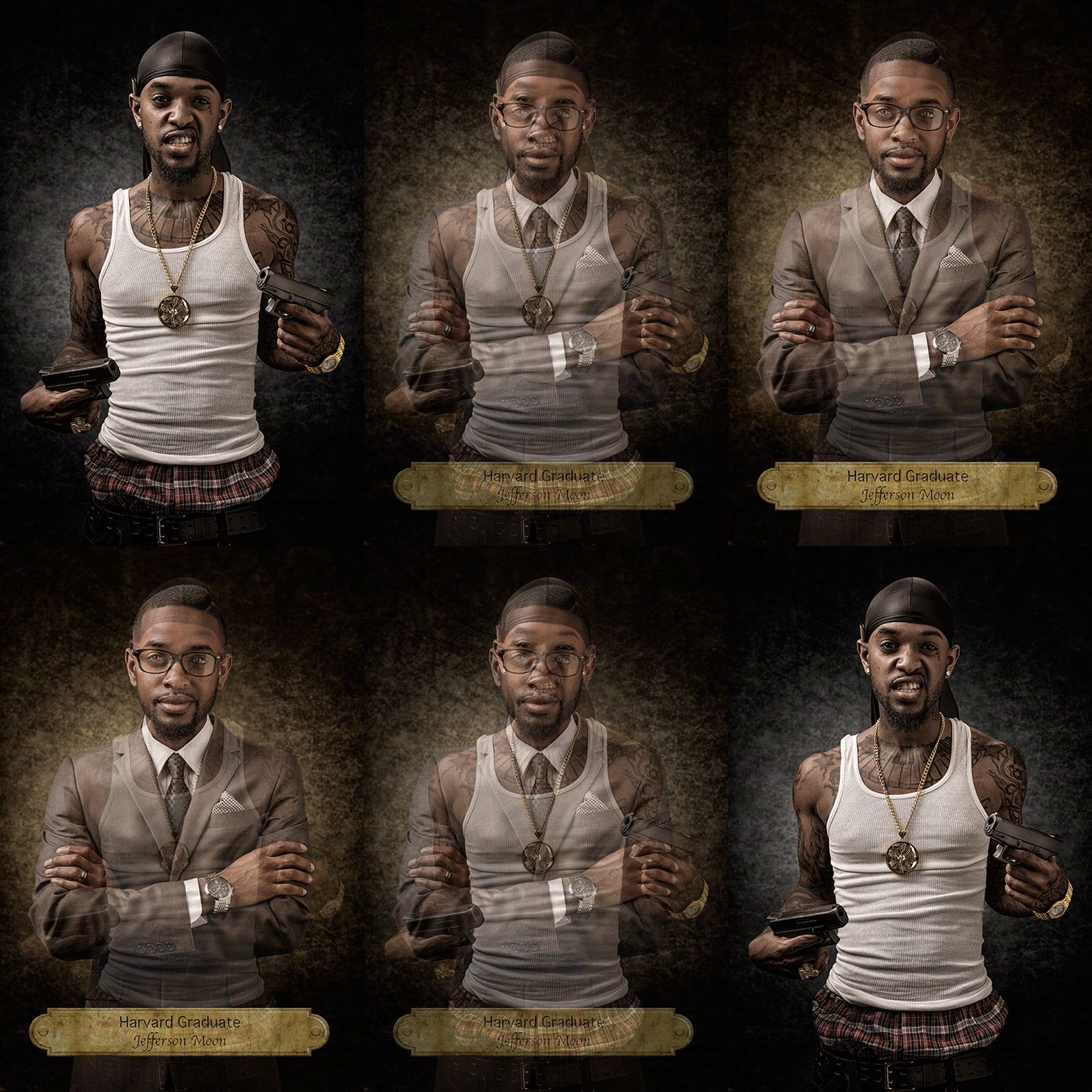
This young man called Jefferson Moon has black skin meaning that he would be seen as a trouble maker, potentially involved in drugs or some sort of crime. He would be dressed in dirty or 'trampy' clothing, whilst maybe wearing his trousers/jeans lower than appropriate. However, as you watch the image change we soon find out he is a Harvard Graduate who is well dressed and seemed to be a very hard working man to achieve his goal in life.
Archetype Definition: a very typical example of a certain person or thing.
Stereotype Definition: a widely held but fixed and oversimplified image or idea of a particular type of person or thing.
Islamophobia: dislike of or prejudice against Islam or Muslims, especially as a political force.
